

Morehouse King Chapel Founding Dean Lawrence Carter Pens Foreword to Bankole Thompson's New Book on America at 250

Dr. Lawrence Edward Carter Sr. is the founding dean of the Martin Luther King Jr. International Chapel at Morehouse College.
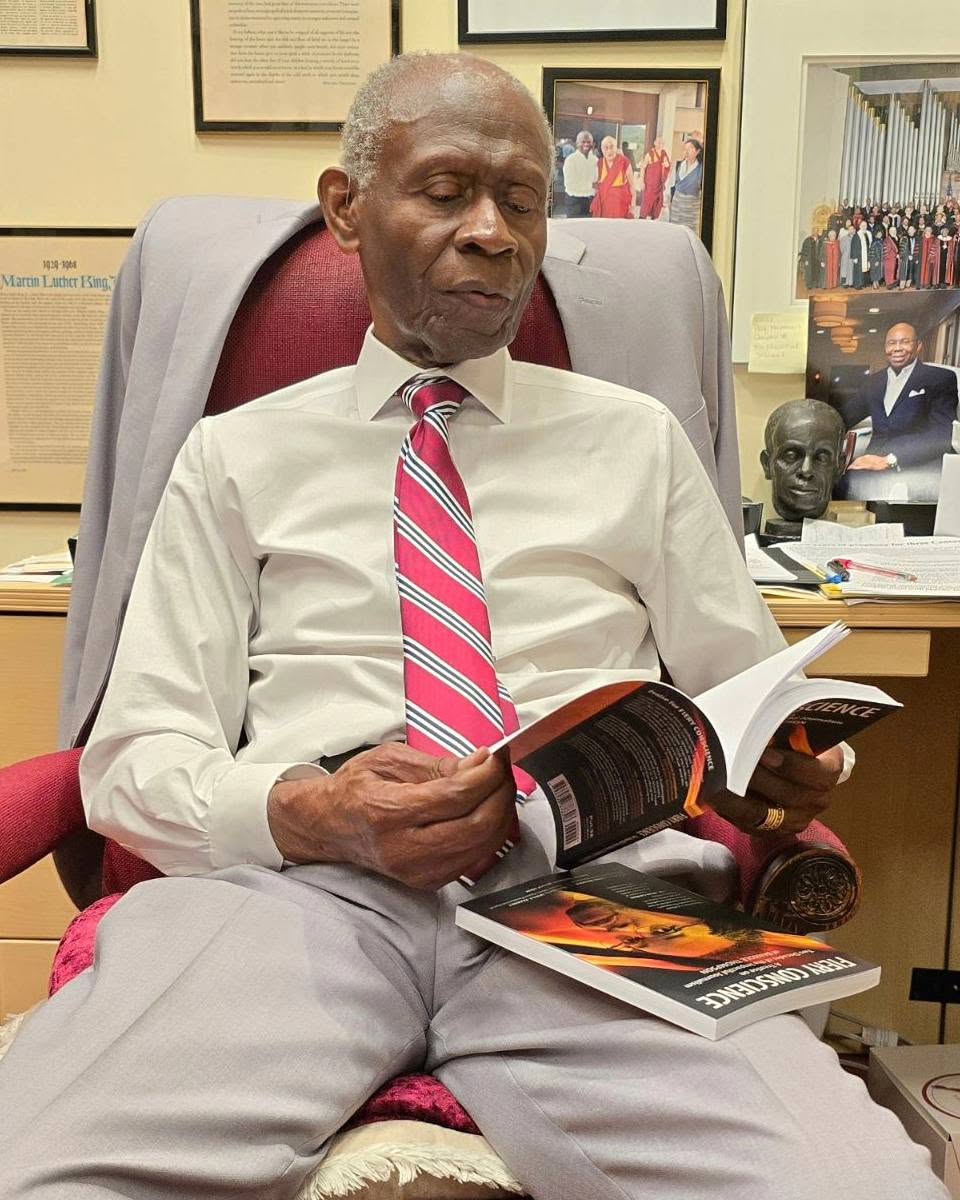
Dr. Lawrence Edward Carter Sr., the founding dean of the Martin Luther King Jr. International Chapel at Morehouse College, reading Bankole Thompson's 2023 book, Fiery Conscience.
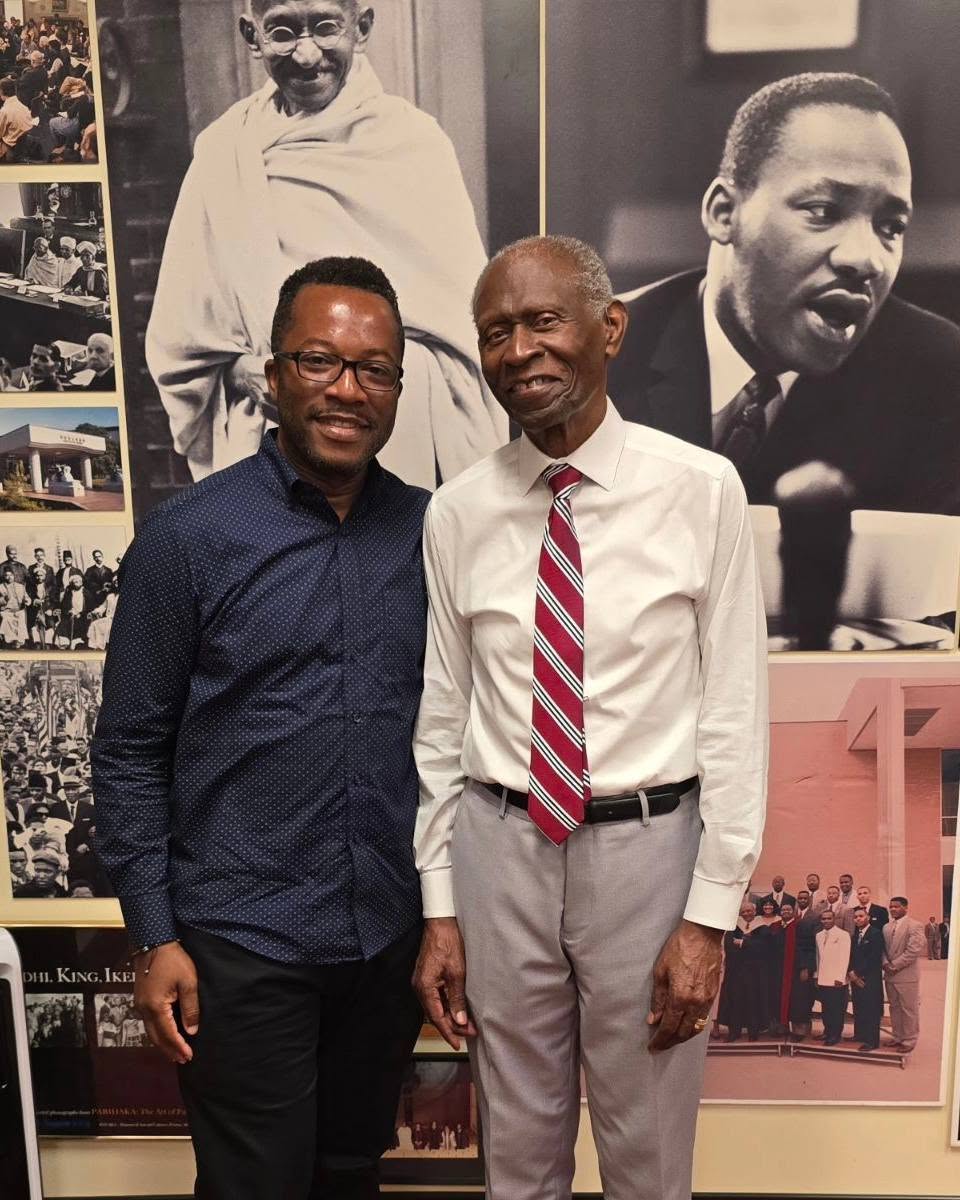
Dr. Lawrence Edward Carter Sr., the founding dean of the Martin Luther King Jr. International Chapel at Morehouse College met with Bankole Thompson in his office at Morehouse in 2024.
Renowned King scholar declares Bankole Thompson "one of America's greatest prophetic journalists" and places his work in the tradition of Martin Luther King Jr.
DETROIT, MI, UNITED STATES, September 8, 2026 /EINPresswire.com/ -- In a consequential assessment connecting one of the nation's leading contemporary journalists to the prophetic tradition of the Rev. Dr. Martin Luther King Jr., renowned King scholar Dr. Lawrence Edward Carter Sr., retired founding dean of the Martin Luther King Jr. International Chapel at Morehouse College, has written the Foreword to nationally acclaimed journalist, author and public intellectual Bankole Thompson’s forthcoming seventh book, "Bankole Thompson’s 12 Moral Questions: Frederick Douglass and the Soul of America at 250."Carter, who has followed Thompson's work over the years, makes an extraordinary declaration in the Foreword: “Bankole Thompson is one of America’s greatest prophetic journalists.”
He goes further, locating Thompson's journalism within the moral tradition that has defined Carter's own intellectual life: “A drum major in the tradition of Martin Luther King Jr., Thompson calls attention to the distance between American practices and the democratic promises of the Declaration of Independence.”
The words carry unusual historical and intellectual weight because of the life and scholarship behind them.
In 1958, Martin Luther King Jr. personally and privately recruited Carter, then a 10th grader, to attend Morehouse College. Carter would eventually become the founding dean of the Martin Luther King Jr. International Chapel at Morehouse and devote nearly half a century to interpreting, preserving and advancing the moral and intellectual traditions associated with King and the global nonviolent movement.
Carter's standing as a national interpreter of that tradition was powerfully demonstrated in January 2025, when he was invited to preach the Martin Luther King Jr. Sunday Eucharist at Washington National Cathedral. Carter delivered the Sunday sermon from the Cathedral's historic Canterbury Pulpit, the same pulpit from which King delivered the final Sunday sermon of his life on March 31, 1968. King was assassinated in Memphis four days later. The Cathedral continues to regard that sermon, Remaining Awake Through a Great Revolution, as one of the defining moments in its own history.
The symbolism is profound because decades after King stood in that pulpit issuing one of his final moral challenges to the nation, Carter, whom King had personally encouraged toward Morehouse as a teenager would ascend the same pulpit to help the country remember and interpret King's legacy.
Carter's influence has also extended across generations of leadership.
Among the Morehouse students he mentored was Rev. Raphael Warnock, who participated in Carter's Chapel Assistants program and would go on to become senior pastor of Atlanta's historic Ebenezer Baptist Church, King's former pulpit, and the first Black person elected to represent Georgia in the United States Senate.
Against that extraordinary continuum, Carter's assessment of Thompson is more than conventional praise for an author. It represents a considered judgment from one of the nation's most respected custodians of the King tradition about a journalist he has followed over time and whose work he believes carries forward the responsibility to summon America toward its democratic promises.
From Douglass And King To America At 250
Bankole Thompson’s 12 Moral Questions arrives as the United States marks the historic threshold of its 250th anniversary.
With Frederick Douglass serving as a central moral interlocutor, Thompson does not approach the anniversary simply as a national celebration. Instead, he asks 12 searching questions about democracy, truth, racial and economic justice, human dignity, leadership, historical memory, conscience and what America owes the generations that will inherit the republic.
At the center of the book is a question connecting Douglass to King and the nation's semiquincentennial: How much distance still exists between America's democratic promises and American practice?
That is precisely the tension Carter identifies in Thompson's journalism.
His description of Thompson, 47, as a “prophetic journalist” recognizes a conception of journalism that reaches beyond recording events. It invokes the responsibility to interrogate power, examine institutions and force the nation to confront the moral consequences of the distance between what it professes and what it practices.
Carter has long followed Thompson's journalism, books and public work. His decision to write the foreword therefore reflects a considered assessment of a body of work rather than a response to any single speech, book or moment.
A Journalistic Record Of Interrogating Power
For more than two decades, Thompson has occupied a distinctive place at the intersection of journalism, democracy, civil rights and public conscience.
A twice-weekly opinion columnist at The Detroit News and longtime former editor of the historic Michigan Chronicle, Thompson was the first editor of a major African American newspaper to conduct a series of exclusive sit-down interviews with Barack Obama during Obama's historic 2008 presidential campaign. The interviews placed Thompson among the Black journalists directly questioning the man who would become the nation's first African American president.
Thompson subsequently authored Obama and Black Loyalty and Obama and Christian Loyalty, extending his examination of the Obama era into questions of race, public policy, faith, political responsibility and the expectations surrounding historic leadership.
His late mentor, Rev. Dr. Bernard LaFayette Jr., Freedom Rider, close King associate and major strategist of the Voting Rights Movement, nominated Thompson to serve on the National Board of the Southern Christian Leadership Conference, becoming the first journalist in American history to do so.
Thompson has also delivered major addresses for Brown University, Michigan State University's Slavery to Freedom Lecture Series, Dillard University and other academic and civic institutions. In 2015, the University of Michigan Bentley Historical Library established the Bankole Thompson Papers to preserve his work for prosperity, a rare honor for a living journalist.
The Anderson Eulogy And The Obligation To Bear Witness
Carter's longstanding regard for Thompson's work was reinforced recently by Thompson's eulogy for legendary civil-rights leader Dr. William G. Anderson, who died at the age of 98. Anderson, a pioneering physician who served as president of the Albany Movement and worked with King during one of the defining campaigns of the Civil Rights Movement, was laid to rest following an August 25, 2026, homegoing service.
Thompson titled his eulogy, “William G. Anderson and the Empty Chair at the Constitutional Convention of 1787.”
Rather than offering only a biographical remembrance, Thompson situated Anderson's life within the longer American struggle over citizenship, constitutional belonging and the exclusion of Black Americans from the nation's original political compact.
The address reflected the same method Carter identifies in Thompson's broader work and that is using history not as ornament, but as a moral instrument for interrogating the present.
Carter And Rosen: Two Traditions Converge On One Book
Carter's foreword follows a major endorsement of Bankole Thompson's 12 Moral Questions from Gerald E. Rosen, former Chief Judge of the U.S. District Court for the Eastern District of Michigan. Rosen served more than 26 years on the federal bench and later became nationally known as the chief judicial mediator in Detroit's historic municipal bankruptcy.
In endorsing Thompson's book, Rosen said its questions “go to the heart of who we are and who we should be as a society” as America enters its next 250 years. He called 12 Moral Questions a “must read for serious students of America and our society's promise to the world.”
Carter and Rosen bring strikingly different forms of authority to Thompson's book.
Carter speaks from Morehouse and the moral-intellectual inheritance of King. Rosen speaks from the federal judiciary and the constitutional and civic institutions of the republic. Yet both encounter in Thompson's work a common question: What must America demand of itself after 250 years?
A Body Of Work Centered On The American Experiment
Thompson is the author of six previous books. His most recent, "HOPE: On The Mountain Of Fear," was published in May 2026 with a Foreword by Sister Simone Campbell, recipient of the Presidential Medal of Freedom. His 2023 book, "Fiery Conscience," was reviewed by Forbes and is listed at the Schomburg Center for Research in Black Culture. His work has repeatedly returned to economic justice, democracy, poverty, racial equality, press freedom and the obligations of leadership and institutions.
As founder and chairman of The PuLSE Institute, an independent anti-poverty think tank, Thompson, has also built an institutional platform for examining economic inequality and the responsibilities of government, business and civic leadership toward marginalized communities.
Now 12 Moral Questions gathers those decades of journalism, civil-rights engagement, institutional inquiry and moral argument into an examination of the country at one of its defining historical thresholds.
Limited Edition Set For November
A limited edition of "Bankole Thompson’s 12 Moral Questions: Frederick Douglass and the Soul of America at 250" will be released in November 2026, ahead of the book's wider publication in 2027.
Carter's Foreword gives the book an unusual intergenerational significance. A scholar personally recruited toward Morehouse by Martin Luther King Jr. as a teenager, who subsequently spent decades cultivating King's moral and intellectual legacy, mentoring future leaders and eventually preaching from the very Canterbury Pulpit where King delivered his final Sunday sermon, is now introducing a book centered on Frederick Douglass and the conscience of America at 250.
The lineage is unmistakable:
Douglass interrogated the republic.
King summoned its conscience.
Carter preserved and transmitted that moral tradition.
And Thompson now asks what that inheritance demands of America at 250.
Carter's declaration that Thompson is “one of America’s greatest prophetic journalists” therefore reaches beyond the customary language of a book foreword. It is an assertion about the role of journalism itself at a moment of national reckoning and about the continuing necessity of voices willing to measure the United States not merely by the history it celebrates, but by the democratic promises it has yet to fulfill.
BANKOLE THOMPSON
The PuLSE Institute
email us here
Legal Disclaimer:
EIN Presswire provides this news content "as is" without warranty of any kind. We do not accept any responsibility or liability for the accuracy, content, images, videos, licenses, completeness, legality, or reliability of the information contained in this article. If you have any complaints or copyright issues related to this article, kindly contact the author above.
