

The latest news from the United States
Provided by AGP
Semiconductor Pump Market Set to Reach USD 6.8 Billion in 2026 as Fab Replacement Cycles Drive Demand
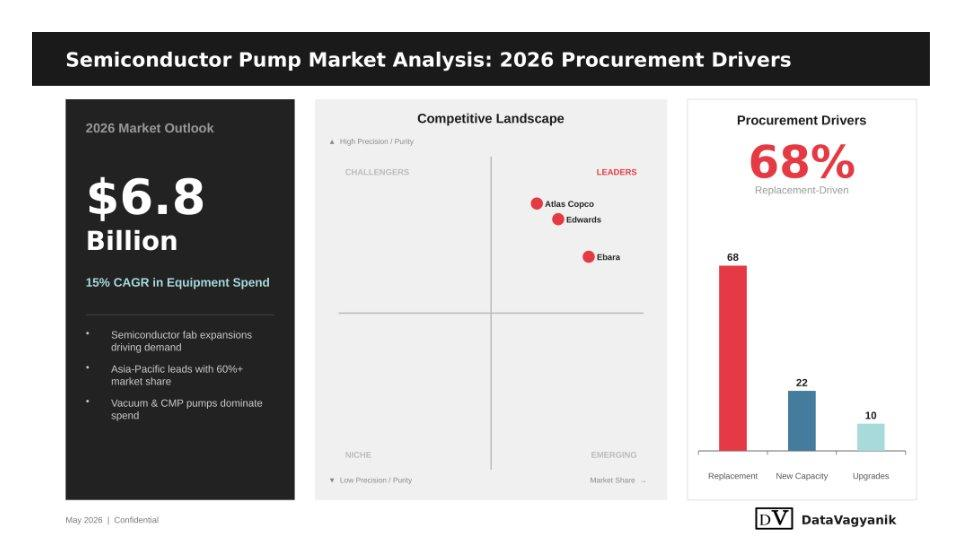
Semiconductor Pump Market Size Forecast to 2026 by DataVagyanik Business Intelligence.
Global semiconductor pump market to hit $6.8B in 2026. DataVagyanik finds 68% of fab operators prioritize system replacements to protect chip yields.
Replacement cycles are outpacing new capacity additions in 2026 as fabs prioritize yield preservation and contamination control in advanced logic and AI-driven HBM production lines.”
DEHRADUN, UTTARAKHAND, INDIA, May 13, 2026 /EINPresswire.com/ -- The pump systems for semiconductor manufacturing market is projected at USD 6.8 billion in 2026, according to DataVagyanik Business Intelligence, as global chipmakers expand fabs, upgrade process lines, and accelerate replacement-driven procurement across vacuum and fluid-handling systems. — Krishna Sharma, Manager, Datavagyanik Business Intelligence
The market is rising alongside semiconductor equipment spending, which DataVagyanik Business Intelligence estimates at USD 135 billion in 2025, up 15% year-on-year. The spending base remains concentrated in major chipmaking hubs, with China contributing USD 49.3 billion, Taiwan USD 31.5 billion, and South Korea USD 25.8 billion. That geographic concentration is sustaining demand for pump systems used in wafer fabrication, chemical handling, high-vacuum processes, and fab utility operations.
Semiconductor manufacturing is among the most demanding industrial settings for pump performance. Equipment reliability, contamination control, and process consistency depend on systems that can handle corrosive chemicals, high-purity fluids, and vacuum-intensive operating conditions. As devices become more complex, pump systems are becoming even more critical to uptime, yield protection, and overall fab efficiency.
Replacement cycles remain the main procurement driver
DataVagyanik Business Intelligence survey data shows that replacement demand is the leading purchasing trigger in 2026, ahead of new capacity additions and process upgrades. In responses from semiconductor fabs and equipment suppliers, 68% of operators identified replacement cycles as their top procurement driver, while 22% cited new fab capacity and 10% pointed to process upgrades.
That pattern reflects the operating realities of semiconductor production, where pumps are exposed to aggressive process chemistries, strict contamination thresholds, and long runtime requirements. For many fabs, replacing aging systems is less about adding capacity and more about preserving yield, lowering leak risk, and maintaining uninterrupted production.
Semiconductor Dry vacuum pumps account for the largest share of planned purchases, while turbomolecular systems remain a niche category for specialized high-vacuum applications. Cryogenic systems continue to serve ultra-high-vacuum environments, and other vacuum subsystems make up the balance.
Dry vacuum pumps lead growth in 2026
The dry vacuum pumps segment leads 2026 growth with an estimated USD 2.9 billion in demand. Widely used in etch, deposition, and abatement, these pumps are essential for advanced process flows that require tighter contamination control and more vacuum steps. By eliminating oil-based risks, they help protect cleanroom integrity and support yield stability.
Adoption is also being supported by longer maintenance intervals and stronger uptime. The category, which includes dry screw, scroll, claw, and hybrid designs, is seeing rising demand in front-end manufacturing, supported by the growth of advanced logic and AI-driven HBM production.
Seal-less centrifugal pumps gain share in fluid handling
Outside vacuum systems, magnetic drive and seal-less centrifugal pumps are among the fastest-growing segments in semiconductor fluid handling, accounting for an estimated 20% to 25% of demand, according to DataVagyanik Business Intelligence.
They are used in chemical transfer, ultrapure water circulation, rinse systems, filtration loops, and waste chemical handling, where leak prevention and contamination control are critical. Compared with shaft-sealed pumps, seal-less designs reduce the risk of failures, downtime, and contamination in corrosive applications, making them increasingly preferred in closed-loop and high-purity wet-process systems.
Diaphragm pumps remain essential in wet processing
Diaphragm pumps remain important in semiconductor manufacturing, especially in chemical dosing, metering, waste chemical transfer, and corrosive fluid handling. DataVagyanik Business Intelligence estimates they account for 15% to 20% of semiconductor fluid-handling pump demand.
They are widely used in wet process tools and chemical distribution systems, where leak prevention and chemical compatibility are critical. Demand is being supported by the expansion of advanced packaging and high-volume production lines, which require precise and reliable dosing.
Etch and deposition remain the most pump-intensive steps
By process, etch and deposition account for the largest share of pump demand at 40% to 50%, due to continuous vacuum pumping, exhaust handling, and gas control. Wet process, cleaning, and wafer rinse applications account for 20% to 25%, while CMP and slurry handling contribute 10% to 15%. Load-lock, wafer transfer, and metrology together represent 8% to 12%.
This reflects the growing vacuum and fluid-handling needs of more complex semiconductor processes, where throughput and yield depend on reliable pump performance.
Competitive landscape remains fragmented outside core vacuum
The semiconductor pump systems market is moderately concentrated in several vacuum categories, but more fragmented in fluid handling and specialty applications. Leading suppliers include Edwards Vacuum, Atlas Copco, Pfeiffer Vacuum + Fab Solutions, Ebara Corporation, ULVAC, Busch Group, Leybold, Ingersoll Rand, KNF, Iwaki, Nikkiso, and ANLET, alongside a broader group of niche suppliers serving semiconductor-grade chemical, ultrapure water, slurry transfer, and specialty fluid-handling applications.
Other companies active in the competitive landscape include Shimadzu Corporation, Agilent Technologies, Osaka Vacuum, Eugene Technology, GST, CS Clean Solutions, Hitachi Industrial Equipment Systems, Kashiyama Industries, SATO VAC, Shincron, CTI-Cryogenics, Brooks Automation, Entegris, CKD Corporation, and Yamada Corporation.
Competition is increasingly defined by qualification depth, contamination control performance, chemical compatibility, service reliability, and energy efficiency. In many cases, suppliers with highly specialized process expertise are favored over those offering the broadest product portfolios.
Outlook
DataVagyanik Business Intelligence expects the semiconductor pump systems market to remain supported by fab expansion, replacement demand, and process intensification through 2026 and beyond. As advanced-node logic, memory, and packaging capacity continue to scale, pump systems will remain a critical part of semiconductor production infrastructure.
The next phase of market growth is expected to be shaped by three factors: higher fab utilization, stricter contamination standards, and a continued shift toward replacement-driven procurement. Together, these trends should support demand not only for new pump installations, but also for upgraded systems that improve uptime, reduce leakage risk, and lower total cost of ownership.
As semiconductor makers expand capacity in Asia and North America, pump suppliers with proven reliability in high-purity, chemically aggressive, and vacuum-intensive environments are expected to remain best positioned for growth.
Browse Adjacent Markets from DataVagyanik, on Semiconductor Manufacturing Ecosystem:
*Connectors and Cables for Semiconductor Manufacturing*
Krishna Sharma
Datavagyanik Business Intelligence
krishna.sharma@datavagyanik.com
Visit us on social media:
LinkedIn
Legal Disclaimer:
EIN Presswire provides this news content "as is" without warranty of any kind. We do not accept any responsibility or liability for the accuracy, content, images, videos, licenses, completeness, legality, or reliability of the information contained in this article. If you have any complaints or copyright issues related to this article, kindly contact the author above.
